
CAST-GNY Entrepreneurship Series: Risk Management and Financing for Start-up Business

The road of entrepreneurship is full of unknown challenges and risks. How to conduct and apply risk management is a major concern of many entrepreneurs and investors. Often, possessing a cutting-edge product or technology does not ensure the commercial viability of a startup. Many aspects of the management of start-up businesses need risk control: from technological risk, commercial risk, financial risk, to legal and regulatory risks. Start-ups and investors need to think ahead of the appropriate measures and choose the right instrument for risk control.
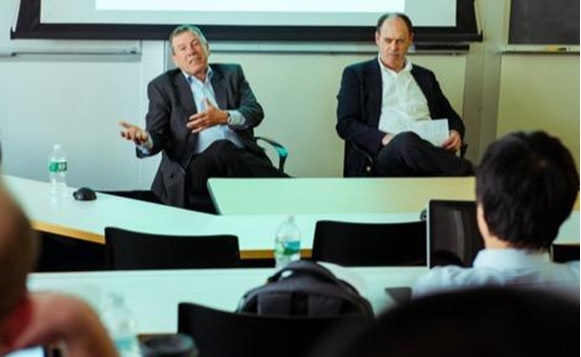
On April 2 2017, CAST-USA held a seminar on “Venture Forum Series – Venture Management and Financing for Start-Ups” at the Columbia University Business School. From the perspective of understanding funding and financing, entrepreneurs were able to learn about how to effectively reduce the risk of entrepreneurship. CAST-USA invited three experts with international risk management and venture capital backgrounds to address some common risks and methods of amelioration, sharing their experiences on what increases the success rate of start-up businesses.
High-tech firms often face two major categories of risk: technological risks and commercial risks. Technological risks include: the ability to achieve technological advantage, the cost of converting technology into a product, challenges associated with intellectual property protection, and risks related to product efficacy and safety. Commercial risks include: the size of the demand for new products, the flexibility of demand, and regulatory hurdles to doing business including acquiring appropriate licenses and permits. Common causes of failure identified were: errors in the business development strategy or inadequate preparation of presentation materials to potential external investors and other stakeholders.
Dr. Dan Galai is an international expert in risk management, financial engineering and derivatives. He’s an advisor to some of the leading Israeli and international financial and governmental agencies. He co-invented the Chicago Board of Options Exchange (CBOE) Volatility Index (VIX). He’s a former Dean of the School of Business Administration at the Hebrew University and a visiting professor at University of California[MP1] and Stern School of Business at NYU. He received his Ph.D. from the University of Chicago, and has published over 100 academic papers in leading journals and is the author of the textbooks The Essentials of Risk Management (2014) and Business Plan Process (2008).
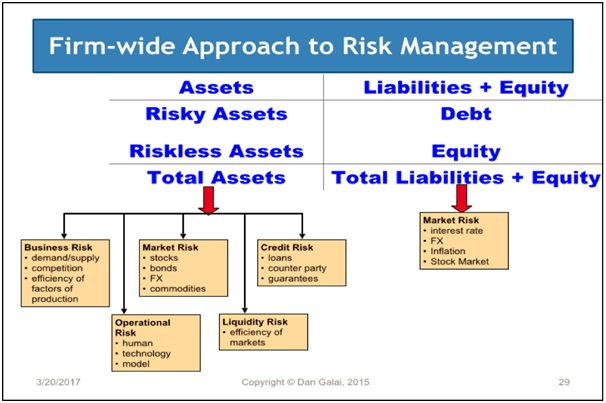
Dr. Galai said that there are 6 steps in Risk Management
Step 1: Determine the objective function
Make sure to be consistent with overall strategic plan, with the risk appetite and financial resources
Step 2: Map the risks, including:
Business risks (technological risks and competing technologies, and willingness of clients to pay)
Financial risks: the amount of funds raised, price of the product, currency mismatch
Non-financial risks: Operational, IT, Reputation, Legal and Regulatory risk
Insurable vs. non-insurable, non-hedgeable risk. Most of the Start-up risks are hard to protect
Step 3: Finding the right instruments for risk management
Step 4: Construct a strategy
Determine risks to hedge or insure, to assume, to share/ reject. SU’s uncertainty is usually substantial.
Determine time horizon for hedging
Budget risk management
Set models and estimate parameters
Step 5: Implement strategy
Be consistent with risk management and business strategy of the firm
Timing of implementation is critical, especially for patents and IT risks
Cost/ Benefit considerations
Synchronization of Various Systems
Step 6: Check performance
Always check against objectives and milestones
Another speaker, Alla Gil[MP2] , provided an excellent complementary information to Dan’s risk control method.
Her Straterix company provides long-term risk management and portfolio analysis for financial services organizations. She shows how to analyze and predict all the different scenarios in a particular market
In terms of financing, angels and venture capital are still the first choice for high-technology start-ups. Crowdfunding from family and business is also a common way. Venture capital funds and investors need to have experts in specific technology fields to help start-ups to maintain product independence and confidentiality, help in managing the start-ups, and help the team to establish network of contacts.

The benefits of crowdfunding are access to many small investors; decentralized, risk diversification, less intervention than team management. The downsides are that the selection process and financial due diligence is not so professional and it brings difficulty for next round funding. [MP3]
The last speaker, Tom Darling, is the Managing Director of Bentley Advisors and has extensive experience in Sino-US investment. He has established more than 20 public or private funds dedicated to investing in emerging markets.
Darling mentioned that Beijing’s Municipal Government now has more than one trillion US dollars Asset Under Management (AUM). The wider Chinese market has more than more than 500 private investment companies, of which some of the largest are conglomerates includingBaidu, Alibaba, Tencent and Foxconn. China now has more than a hundred angel investors and venture capital funds.

An interesting statistic he pointed out was that out of 100 start-up projects, only 5 will succeed commercial success, and only 2 will achieve outstanding results. The success rate of angels and venture capitalists is less than 10%. Difficulties and barriers, such as how to develop academic research into products, may reduce interest of investors into certain technological fields.
Our event host, Lin Fan Yu, is also a founder of a start-up company, Fluxus LLC. She said: “I had not previously thought about risk management in such a systematic way. After today’s discussion, I started to take legal, regulatory, and reputational risks into consideration. Also I will try to find a way to turn those risks into our core competitive advantages.”
She also said, “I love what Dr. Galai said about risk. Don’t avoid it. Seek It. Where others see risk, an entrepreneur sees opportunity.”
Edit: Siyi Sun
Translate: Siyi Sun
April 2, 2017